
1-inch grid paper, a foundational tool for various disciplines, features a matrix of one-inch squares, aiding precision and visual organization․
This versatile paper simplifies tasks requiring accurate measurements, scaling, and proportional representation, proving invaluable across diverse applications․
What is 1-Inch Grid Paper?
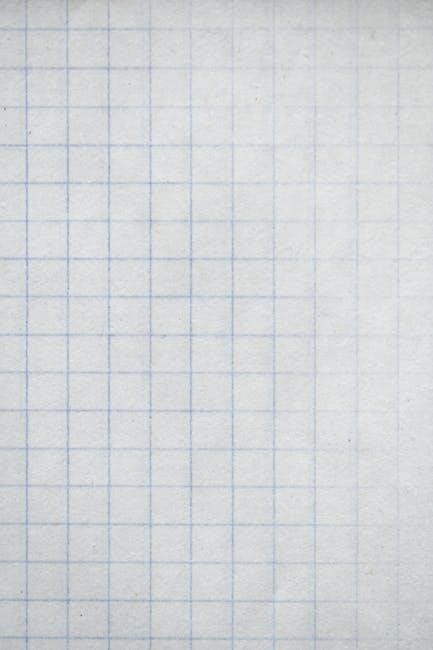
1-inch grid paper is a type of graph paper characterized by a network of squares, each measuring precisely one inch on each side․ These squares are typically created by drawing horizontal and vertical lines spaced one inch apart, forming a consistent grid across the entire sheet․ The lines are usually, but not always, printed in a light color – often gray or light blue – to minimize interference with any markings or drawings made on the paper․
This specific grid size is particularly useful for tasks requiring moderate precision and is a popular choice for a wide range of applications․ Unlike smaller grid sizes, it’s easily readable and manageable for hand-drawn diagrams․ The availability of 1-inch grid paper PDFs online makes it readily accessible for digital use, printing, or importing into design software․ It’s a fundamental tool for students, designers, and professionals alike․
Common Uses for 1-Inch Grid Paper
1-inch grid paper finds extensive application across numerous fields․ In education, it’s invaluable for mathematics, aiding in graphing functions, understanding area and volume, and visualizing geometric concepts․ Science classes utilize it for plotting data, creating charts, and designing experiments․ Beyond academics, architects and engineers employ it for preliminary sketches and scaled drawings, ensuring proportional accuracy․
Designers leverage the grid for layout planning, whether for room arrangements, garden designs, or user interface mockups․ The accessibility of 1-inch grid paper PDFs expands its utility to digital art, pixel art creation, and game development․ Even hobbies benefit, such as cross-stitch pattern design or miniature wargaming terrain layout․ Its versatility makes it a staple for anyone needing a visual aid for planning and precision․

Finding 1-Inch Grid Paper PDFs Online
Numerous websites offer free and paid 1-inch grid paper PDFs, providing convenient access for download and printing, catering to diverse user needs․
Free Printable PDF Sources
Locating free 1-inch grid paper PDFs is surprisingly straightforward, with several reputable online resources readily available․ Websites dedicated to printable templates, like PrintablePaper․net and Vertex42․com, consistently offer a variety of grid paper options, including the standard 1-inch grid․ These sites typically allow users to download PDFs directly, often with customizable options such as paper size and orientation․
Furthermore, educational resource websites frequently provide free grid paper downloads for students and teachers․ Many school districts also host printable resources on their websites․ A simple Google search using keywords like “free 1-inch grid paper PDF” will yield a plethora of results, though it’s always prudent to verify the source’s legitimacy before downloading any files․ Remember to check for any usage restrictions or copyright information associated with the downloaded PDFs․
Paid Options for High-Quality PDFs
While numerous free 1-inch grid paper PDFs exist, opting for paid options can provide enhanced quality and features․ Platforms like Etsy and specialized graphic design marketplaces offer professionally designed grid paper templates, often with higher resolution and more intricate gridline styles․ These paid resources frequently include variations beyond the standard 1-inch grid, such as different colors, line weights, and even pre-printed headers or footers․
Purchasing PDFs can also support independent designers and ensure consistent quality across multiple prints․ Some vendors offer bulk discounts or subscription services for frequent users․ Consider paid options if you require exceptionally crisp print quality, specific customization needs, or wish to avoid potential copyright concerns associated with freely distributed resources․ These premium PDFs often streamline workflows and deliver a polished, professional aesthetic․
Advantages of Using a PDF Format
PDFs ensure consistent presentation of 1-inch grid paper across all devices and operating systems, preserving formatting and print quality reliably and universally․
Portability and Accessibility
PDFs excel in portability, allowing easy distribution of 1-inch grid paper across various platforms – computers, tablets, and smartphones – without formatting alterations․ This accessibility extends to diverse operating systems, ensuring compatibility regardless of the user’s technological setup․ A PDF document maintains its intended appearance, crucial for precise work requiring consistent grid alignment․
Furthermore, PDFs are readily shareable via email, cloud storage, or websites, facilitating collaboration and resource sharing․ No specialized software is typically needed to open a PDF, as most devices have built-in PDF viewers․ This widespread availability makes 1-inch grid paper in PDF format a convenient and universally accessible tool for students, designers, and professionals alike, promoting seamless workflow and efficient project management․
Consistent Formatting Across Devices
PDFs guarantee consistent formatting, a critical advantage when utilizing 1-inch grid paper․ Unlike other document formats prone to rendering differences based on software or operating system, a PDF preserves the original layout precisely․ This means the grid lines, dimensions, and any annotations will appear identical on any device – from a high-resolution desktop monitor to a mobile phone screen․
This reliability is paramount for tasks demanding accuracy, such as architectural sketches, mathematical graphing, or design layouts․ The assurance that the grid remains uniform eliminates potential errors caused by scaling or font variations․ PDFs embed fonts and graphics, preventing substitution issues․ Consequently, 1-inch grid paper PDFs offer a dependable and predictable visual experience, regardless of where or how they are viewed, ensuring project integrity․
Applications in Mathematics and Science
Mathematical and scientific fields extensively utilize 1-inch grid paper for precise graphing, data visualization, and geometric constructions, enhancing analytical clarity․
Graphing Functions
Utilizing 1-inch grid paper significantly simplifies the process of graphing mathematical functions, providing a clear visual representation of their behavior․ The consistent grid spacing allows for accurate plotting of points, enabling students and professionals alike to analyze curves, identify key features like intercepts and asymptotes, and understand the relationship between equations and their graphical forms․
The one-inch increments facilitate easy scaling of axes, accommodating various function ranges and ensuring proportional accuracy․ This is particularly useful when dealing with trigonometric functions, exponential growth, or logarithmic scales․ Furthermore, the grid assists in determining the slope of a line or the rate of change of a curve, crucial concepts in calculus and related fields․ The visual clarity offered by the grid minimizes errors and promotes a deeper understanding of function properties․
Drawing Geometric Shapes
1-inch grid paper is an exceptional aid when constructing and analyzing geometric shapes with precision․ The gridlines act as a reliable guide for drawing accurate lines, angles, and curves, making it ideal for tasks ranging from basic geometry lessons to complex architectural sketches․ Students can easily visualize and create squares, rectangles, triangles, and other polygons, understanding concepts like area, perimeter, and symmetry․
The consistent grid spacing allows for precise scaling of shapes, enabling the creation of similar figures with different dimensions․ This is particularly useful in technical drawing and design․ Moreover, the grid facilitates the calculation of areas and volumes, as each square represents a known unit․ The visual structure promotes spatial reasoning and enhances the understanding of geometric principles, fostering a stronger grasp of mathematical concepts․

Practical Uses Beyond Academics

Beyond classrooms, 1-inch grid paper excels in design projects, garden planning, and even crafting pixel art, offering structure and scalability for creative endeavors․
Design and Planning (e․g․, Garden Layouts)
For designers and planners, 1-inch grid paper provides a tangible medium for visualizing spatial arrangements and layouts before implementation․ This is particularly useful in landscape architecture and garden design, where accurately representing plant placement, pathways, and structures is crucial․
Each square on the grid can represent a specific unit of measurement – a foot, a meter, or any other desired scale – allowing for precise scaling of the design․ Gardeners can sketch out their plots, experimenting with different arrangements of flowers, vegetables, and shrubs to optimize space and sunlight exposure․ Interior designers can similarly utilize the grid to plan furniture arrangements within a room, ensuring optimal flow and functionality․
The grid also aids in calculating areas and perimeters, assisting with material estimations for projects․ Beyond gardens and interiors, it’s valuable for event planning, booth layouts, or even miniature architectural models, offering a simple yet effective tool for bringing ideas to life․
Pixel Art and Digital Design
Surprisingly, 1-inch grid paper finds a niche in the realm of digital art, specifically pixel art and initial digital design concepts․ The grid serves as an analog precursor to the pixel-based world, allowing artists to visualize and plan designs at a fundamental, pixel-by-pixel level․
Each square on the paper directly corresponds to a pixel, enabling artists to sketch out character sprites, game environments, or icon designs before transferring them to digital software․ This method fosters a deeper understanding of pixel limitations and encourages deliberate design choices․ It’s a fantastic way to practice color palettes and shading techniques․
Furthermore, the grid assists in scaling designs for different resolutions․ Designers can easily map out a small-scale design on the paper and then scale it up proportionally for larger displays․ It’s a low-tech, tactile approach that complements digital workflows beautifully, fostering creativity and precision․

Customizing 1-Inch Grid Paper PDFs
PDFs offer flexibility; users can add text, annotations, or adjust print settings like scaling and orientation to tailor 1-inch grid paper for specific needs․
Adding Text and Annotations
PDF editors empower users to directly annotate 1-inch grid paper PDFs, enhancing their utility for diverse applications․ This functionality allows for the inclusion of labels, notes, dimensions, or any relevant textual information directly onto the grid․
Features commonly include text boxes, highlighting tools, and freehand drawing capabilities, facilitating clear communication and detailed documentation․ For instance, when utilizing grid paper for design layouts, adding descriptive text clarifies elements and dimensions․
In scientific contexts, annotations can denote data points or experimental observations․ Furthermore, many PDF viewers allow for commenting and feedback, making collaborative work seamless․ The ability to add these layers of information transforms static grid paper into a dynamic and interactive tool, maximizing its value․
Adjusting Print Settings (Scaling, Orientation)
Printing 1-inch grid paper PDFs requires careful attention to print settings to ensure accuracy․ Scaling options are crucial; verifying that the PDF prints at 100% size prevents distortion of the grid․ Incorrect scaling alters the intended one-inch square dimensions, compromising precision․
Orientation settings – portrait or landscape – should align with the intended use․ Landscape mode is often preferred for wider layouts, while portrait suits taller designs․ Furthermore, paper size selection must match the PDF’s dimensions․
Experimenting with these settings on a test print is recommended before committing to a full print run․ Adjustments may be necessary based on the printer and PDF viewer used, guaranteeing the grid’s integrity and usability for intended applications․

Software for Creating and Editing Grid Paper
Various software options facilitate grid paper creation and modification, including Microsoft Excel, Word, and specialized grid paper generators for customized PDFs․
Microsoft Excel/Word
Microsoft Excel and Word offer surprisingly robust capabilities for generating 1-inch grid paper․ Within Excel, adjusting cell sizes to one inch and utilizing borders creates a basic grid․ Users can then scale and print this grid as needed, customizing line weights and colors for clarity․ Word provides similar functionality through tables; inserting a table and modifying row height and column width to one inch, followed by border application, yields a printable grid․
However, achieving precise 1-inch measurements requires careful configuration of page setup and print scaling․ These programs aren’t specifically designed for grid paper, so iterative adjustments might be necessary․ Despite this, Excel and Word represent accessible options for creating simple grids without dedicated software, particularly useful for quick, one-off needs․ Saving the created grid as a PDF ensures portability and consistent formatting across different devices and operating systems․
Dedicated Grid Paper Generators
Numerous online dedicated grid paper generators streamline the creation of 1-inch grid PDFs, offering features tailored specifically for this purpose․ These tools typically allow users to specify grid size (1-inch being a common option), page orientation, and margins with greater precision than general office software․ Many generators also provide options for customizing line color, weight, and style, enhancing readability and usability․
Examples include websites offering downloadable PDFs or interactive generators where users can preview and adjust the grid before downloading․ These specialized tools eliminate the need for manual adjustments in programs like Excel or Word, saving time and ensuring accuracy․ The resulting PDFs are often optimized for printing, providing clean, crisp grid lines․ They represent a convenient solution for frequent grid paper users needing consistent, high-quality results․